Building a website without a solid foundation is like constructing a house on quicksand. Before you start designing your homepage or writing blog posts, you have a critical decision to make. If you are wondering how to choose a web hosting provider, you are absolutely in the right place. Selecting the right host is the single most important technical decision you will make for your online presence.
In this comprehensive guide, we will break down the best web hosting factors to consider, explore the various types of web hosting available, and show you exactly what to look for before handing over your credit card details. Furthermore, we will walk you through the nuances of server performance, uptime guarantees, and essential security features. Therefore, grab a cup of coffee, and let’s dive into the ultimate blueprint for finding the perfect home for your website.
Why Choosing the Right Web Hosting Matters
To begin with, you might be tempted to simply pick the cheapest hosting option available and call it a day. However, this is one of the most common mistakes new website owners make. Your web host directly determines your site’s speed, security, and reliability.
The Impact on Website Speed and SEO
First and foremost, Google has explicitly stated that website performance and security directly influence your search engine rankings. Consequently, if your hosting provider uses outdated server hardware or oversold servers, your Core Web Vitals will suffer. A fast loading website improves user experience, reduces bounce rates, and signals to search engines that your site is high quality.
Speed metrics impact your search rankings directly. Source: DebugBear
As a result of slow loading times, you risk losing potential customers and valuable organic traffic. Therefore, prioritizing a host with optimized server stacks and SSD or NVMe storage is non-negotiable.
Uptime Reliability for Your Business
In addition to speed, your website must be accessible at all times. Uptime refers to the percentage of time your website is online and available to visitors. While a “99%” uptime guarantee might sound impressive, it actually translates to over seven hours of downtime per month. Even short downtime periods can cost you leads, ad revenue, and brand trust. Thus, you should strictly look for a 99.9% uptime guarantee or higher as the absolute minimum standard.
Types of Web Hosting: Which Should You Choose?
Before you can choose a specific company, you need to understand the architectural options. The hosting market offers various environments tailored to different traffic volumes and technical requirements.
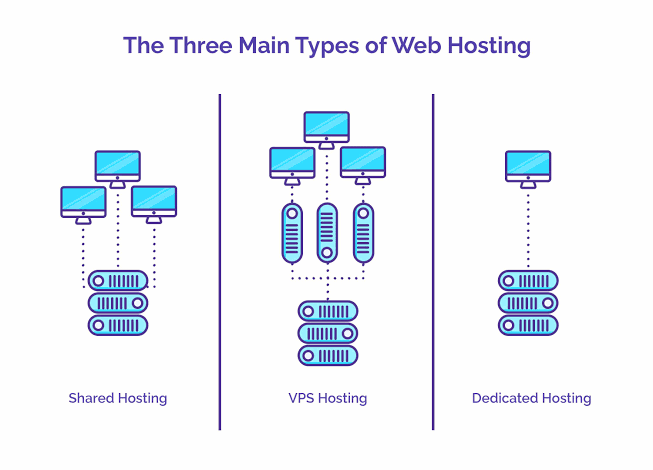
Visualizing Shared vs VPS vs Dedicated servers. Source: YourLastHost
Shared Hosting
Shared hosting is the most common entry level option. In this scenario, your website shares a single physical server and all its resources with hundreds of other websites.
- Best for: Beginners, personal blogs, and low-traffic informational sites.
- Pros: Highly affordable and very easy to set up.
- Cons: Inconsistent performance and limited scalability. If another site on your server experiences a traffic spike, your site might slow down.
VPS (Virtual Private Server) Hosting
Meanwhile, VPS hosting provides a fantastic middle ground. While you still share physical hardware with others, the server is partitioned into virtual environments. Therefore, you have dedicated, guaranteed resources (RAM, CPU) that cannot be drained by neighboring sites.
- Best for: Growing websites, medium-sized businesses, and high-traffic blogs.
- Pros: Better performance, more control, and enhanced security compared to shared hosting.
- Cons: Slightly more expensive and requires a bit more technical knowledge, though fully managed options exist.
Dedicated Hosting
For maximum performance, dedicated hosting gives you an entire physical server exclusively for your website.
- Best for: Large enterprise businesses and massive e-commerce stores.
- Pros: Ultimate control, top tier security, and maximum computing power.
- Cons: It is the most expensive option and usually requires an in house system administrator.
Cloud Hosting
Recently, cloud hosting has emerged as the modern gold standard. Instead of relying on a single physical machine, your site draws resources from a clustered network of servers.
- Best for: High growth e-commerce, SaaS platforms, and sites with fluctuating traffic spikes.
- Pros: Incredible scalability and high reliability. If one server fails, another instantly takes over.
- Cons: Pricing can sometimes be unpredictable since you often pay for exactly what you consume.
Key Factors to Evaluate When You Choose a Web Hosting Provider
Now that you know the types of hosting, how do you differentiate between providers within those categories? Use this criteria checklist to decide wisely.
Performance and Speed Guarantees
Beyond just storage space, look at the underlying technology. Modern hosts use Solid State Drives (SSDs) or NVMe drives, which are dramatically faster than old-school Hard Disk Drives (HDDs). Furthermore, check if they offer built-in server-level caching (like LiteSpeed) and have data centers physically located near your primary target audience. For example, if you are targeting a USA audience, your server should ideally be located in North America to minimize latency.
Security Features and SSL
Security should be proactive, not reactive. A reputable host must offer a free SSL certificate to encrypt data between your site and your users. In addition, look for Web Application Firewalls (WAF), automated daily backups, DDoS protection, and active malware scanning. Never compromise on these features, as they protect both your sensitive data and your brand’s reputation.
Customer Support and Scalability
When your site goes down at 3 AM on a Saturday, you need immediate help. Consequently, 24/7 expert support is absolutely paramount. Always prioritize companies that offer live chat and phone support with fast response times. Moreover, test their pre-sales support by asking a technical question before signing up.
Additionally, ensure there is a clear path for scalability. As your organic traffic grows, upgrading your plan should be a seamless, one-click process rather than a complicated migration ordeal.
Pricing and Renewal Rates
Finally, beware of the price versus value trap. Many providers offer incredibly low introductory prices (e.g., $2.95/month) that skyrocket upon renewal (e.g., $10.95/month). Always read the fine print to understand the long-term costs. Furthermore, remember that “unlimited” bandwidth or storage is rarely truly unlimited; it usually comes with strict fair-use clauses hidden in the terms of service.
Web Hosting Comparison Features
To make visualizing your specific needs easier, use the interactive tool below to map your traffic expectations and technical expertise against the ideal hosting environment.
Was this visual helpful?
YesNo
Key insight: Don’t just buy for the traffic you have today. Use the interactive sliders above to see how your hosting needs will evolve as your monthly visitors scale up over the next year.
How to Make Your Final Choice
Ultimately, making your final decision requires matching your specific business goals with the right technology stack.
The 5-Step Process for Beginners
If you are feeling overwhelmed, follow this simple, actionable process:
- Identify your exact needs: Determine your expected traffic, budget, and platform (e.g., WordPress vs. custom build).
- Select the hosting category: Decide between Shared, VPS, or Cloud based on your current stage of business.
- Shortlist candidates: Pick 2 or 3 highly-rated providers known for excellent uptime and speed.
- Evaluate the features: Compare their security protocols, backup policies, and renewal costs.
- Test the support: Reach out to their technical team to gauge response time and expertise.
Feature Comparison At-A-Glance
| Feature Requirement | Shared Hosting | VPS Hosting | Cloud Hosting |
| Traffic Capacity | Low to Medium | Medium to High | Highly Scalable |
| Server Control | Minimal | Root Access | Flexible Setup |
| Cost Profile | Very Affordable | Moderate | Pay-As-You-Go |
| Security Risk | Higher (Shared Space) | Isolated Environment | Highly Secure |
Choosing the right hosting provider is a critical first step, much like laying a solid foundation for a physical building. Focus on performance and support rather than lowest prices, and your website will be set for lasting SEO success..
Ready to take the next step and launch your digital presence? Evaluate your budget, map out your growth goals, and secure a web host that will help your business thrive today!
FAQs:
- How much should I expect to pay for good web hosting?
Shared hosting typically ranges from $3 to $10 per month, VPS hosting ranges from $20 to $50 per month, and specialized managed cloud hosting can start around $30 and scale up based on usage. Always check the renewal rates.
- Is it possible to upgrade my hosting plan later if my traffic increases?
Yes. Most reputable providers allow you to easily scale up from shared hosting to a VPS or Cloud plan without experiencing significant downtime.
- Do I need specialized WordPress hosting?
While not strictly required, managed WordPress hosting provides optimized server caching, automated core updates, and expert support specifically tailored for WordPress, making it highly recommended for business sites.
- How does web hosting directly impact my SEO?
Google considers Core Web Vitals as a ranking factor. A fast, reliable host with secure infrastructure ensures quick page loading times and maximum uptime, both of which are critical for high search engine rankings.
Key Takeaways:
- Always prioritize uptime guarantees (99.9%+) and modern server speed (SSD/NVMe).
- Shared hosting is best for beginners, but Cloud or VPS is required for growing e-commerce businesses.
- Never choose a host solely based on the cheapest introductory price; check the renewal fees.
- 24/7 expert customer support is non-negotiable for protecting your online revenue.
Conclusion:
Figuring out exactly how to choose a web hosting provider doesn’t have to be a frustrating guessing game. By understanding the different types of web hosting from basic setups to specialized managed WordPress hosting and rigorously evaluating the best web hosting factors, you can make a decision that actively boosts your SEO rather than holding it back.
Whether you are comparing dedicated vs shared hosting or closely analyzing a provider’s hosting uptime guarantee and overall web host performance, the right infrastructure is critical to your success. Review the key elements for choosing a hosting company outlined in this guide, select a provider that perfectly aligns with your growth trajectory, and start building your online empire on a rock-solid foundation!